Tell Us What Happened
Describe the Uptown or Carrollton property location, apparent water source, affected rooms, whether standing water remains and whether the source has been stopped.
Water damage restoration in Uptown New Orleans starts with the source: plumbing, an appliance, roof or storm intrusion, outdoor floodwater, sewage or another water event. Homes across Uptown and Carrollton can contain layered flooring, plaster, drywall, wood and concealed cavities where moisture may travel beyond the first visible stain or puddle.
Call (866) 203-7057 • Residential New Orleans requests • Provider availability depends on location and service need
Water Damage Restoration New Orleans helps qualifying homeowners connect with independent local service providers. We do not perform the restoration work ourselves, so the connection process is intentionally straightforward and transparent.
Describe the Uptown or Carrollton property location, apparent water source, affected rooms, whether standing water remains and whether the source has been stopped.
Provider availability depends on the property location, type of residential water-damage request and participating provider capacity.
If connected, review the proposed scope, qualifications, timing, pricing, licensing and insurance directly with the independent provider before hiring.
Independent providers set their own prices based on the actual property conditions and proposed restoration scope. Pricing can differ between providers, so homeowners should understand what is included before authorizing service.
A larger national company and an independent provider may have different operating models, service approaches and pricing structures. That does not mean one will always cost less than the other.
Uptown and Carrollton contain residences from different construction periods and with different wall, flooring, foundation and roof assemblies. The restoration scope should follow the actual building and water path rather than assuming every older New Orleans home is built the same way.
Some properties may contain plaster, wood flooring, masonry, traditional trim or multiple generations of finishes that need material-specific decisions after becoming wet.
Water entering an upper level, wall or ceiling can travel downward into cavities, flooring systems or rooms below before the full affected area becomes visible.
Updated flooring, cabinets or drywall may cover older materials or hidden cavities, so visible finishes do not always reveal the full construction beneath them.
Where structures or occupied spaces are close together, identifying the actual source and moisture boundary becomes especially important before assuming the loss is limited to one room.
Different water sources create different restoration questions. A plumbing failure, roof leak, appliance leak, storm event, outdoor floodwater and sewage backup should not automatically receive the same cleanup approach.
Plumbing failures can release water behind walls, above ceilings, beneath floors or across several rooms before the source is stopped.
Burst pipe water damage →Water entering from above can affect roofing assemblies, ceilings, insulation, wall cavities and interior finishes.
Roof leak water damage →Washing machines, dishwashers, refrigerators and other water-connected appliances can wet flooring, cabinets and nearby walls.
Appliance leak water damage →Wind-driven rain can enter through roofing, windows, doors or other building-envelope openings without outdoor floodwater entering the residence.
Storm water damage →Water entering from streets, yards or other exterior surfaces raises different contamination and material-cleanup questions.
Flood cleanup →Sewage and wastewater should not be treated like ordinary indoor supply water because contamination changes the cleanup approach.
Sewage backup cleanup →NOLA Ready explains that heavy rainfall can exceed the amount of water the ground and drainage system can absorb or move, resulting in street and urban flooding in New Orleans.
That distinction matters inside the home. Rain entering through a roof or window is not automatically the same restoration situation as exterior floodwater moving into the residence.
Roof or building-envelope intrusion usually starts with controlling the entry point and evaluating the interior materials along the water path.
Storm water damage guidance →Water that crossed outdoor surfaces before entering the residence may involve different contamination and material decisions.
Flood cleanup guidance →During the July 11, 2026 rain event, the Sewerage & Water Board reported that Uptown, Hollygrove and Carrollton received more than 3.5 inches of rain in one hour. SWBNO also reported significant flooding in parts of Uptown and high water around the Carrollton Underpass during that event.
Separately, SWBNO documented water-main breaks affecting portions of Uptown during 2026.
See the SWBNO July 2026 rainfall update .
Water moves through seams, openings, cavities and connected materials. A stain on a ceiling or wall can appear some distance from the original entry point.
Likewise, a puddle on finished flooring does not show whether water moved beneath the surface into underlayment, subflooring, wall bases or adjoining rooms.
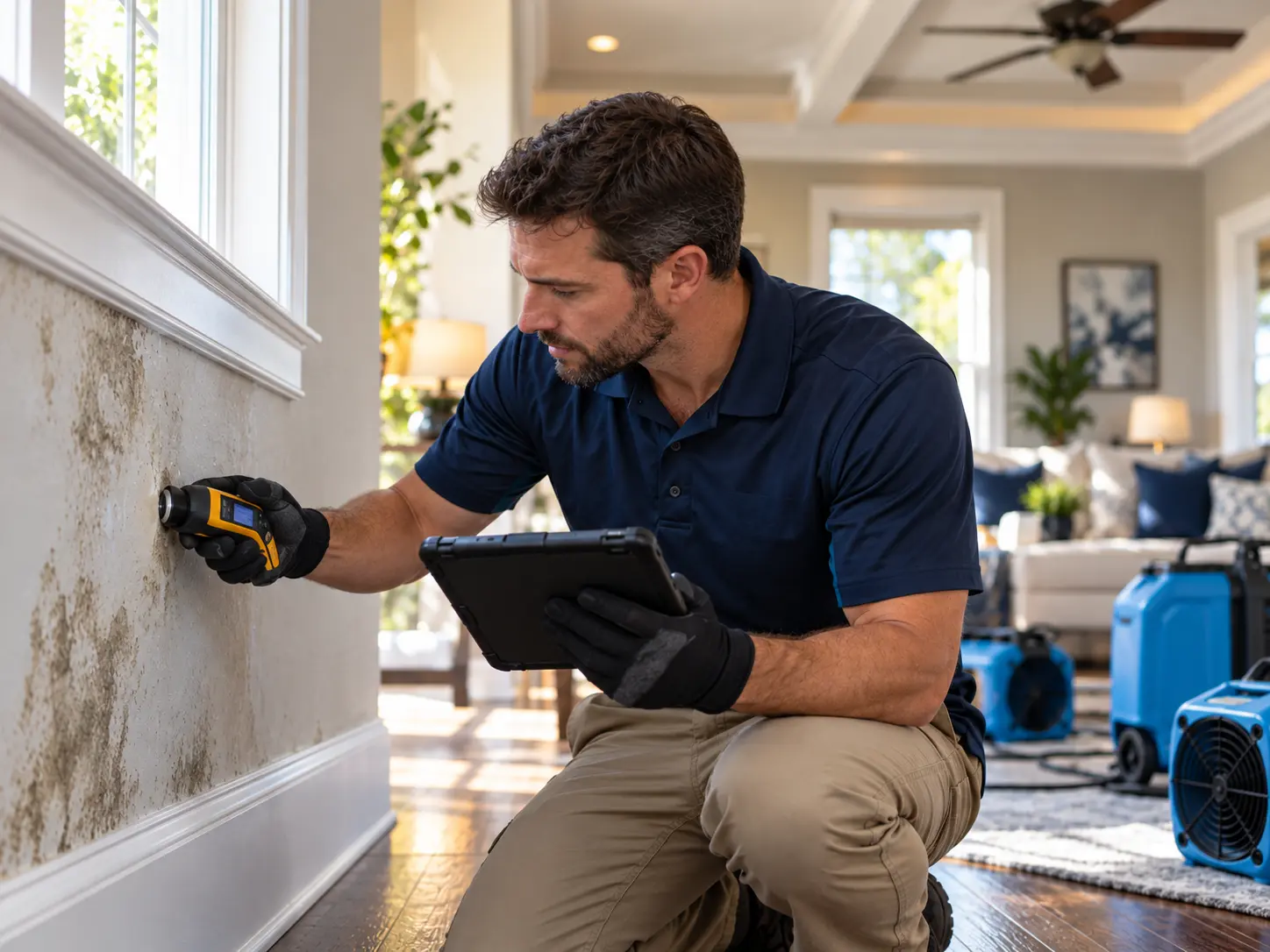
A useful restoration scope should identify what is actually present in the home instead of treating every wet wall or floor as the same material.
| Material / Area | What Should Be Evaluated |
|---|---|
| Plaster or layered walls | Physical condition, what materials are behind the finish, the moisture path and whether the assembly can be appropriately evaluated or dried. |
| Drywall | Saturation, source of water, physical condition, insulation behind the wall and whether concealed materials are also wet. |
| Wood flooring | Moisture beneath the surface, movement or cupping, finish condition, subfloor moisture and drying potential. |
| Subflooring | Moisture beneath finished flooring, physical condition and access for evaluation or drying. |
| Cabinets | Water beneath cabinet bases, toe kicks, adjacent flooring, swelling and moisture behind fixed components. |
| Structural wood | Moisture condition, physical damage, access and whether the material can remain while drying proceeds. |
The City of New Orleans identifies Uptown and most of Carrollton as partial-control historic districts for HDLC demolition review. Carrollton Avenue is listed separately as full-control.
This does not mean ordinary water mitigation automatically requires an HDLC hearing. It means homeowners should check the exact property and proposed permanent repair scope when restoration becomes significant demolition or exterior work.
Extraction, drying and investigation of wet materials address the immediate water problem. Permit requirements depend on the actual work being performed.
Significant demolition, exterior changes or reconstruction can raise separate City or HDLC questions depending on the property's district and scope.
Review the City's current HDLC demolition-review guidance and confirm the property's specific district before planning major permanent repairs.
Different types of water damage require different restoration decisions. Use the situations below to find detailed guidance for the problem affecting your Uptown or Carrollton home.
| Situation | Service | Main Question |
|---|---|---|
| Standing or removable water remains | Water Extraction | What water should be removed before material drying continues? |
| Walls, floors or ceilings remain wet after visible water is gone | Structural Drying | Which building materials are still retaining moisture? |
| A pipe or plumbing line failed | Burst Pipe Water Damage | Has the source been stopped and where did the released water travel? |
| Dishwasher, washer, refrigerator or another appliance leaked | Appliance Leak Water Damage | Did moisture move below flooring, cabinets or adjoining areas? |
| Water is coming from the roof or ceiling | Roof Leak Water Damage | Has the exterior source been controlled and what became wet inside? |
| Severe weather caused building-envelope water entry | Storm Water Damage | Where did weather enter and is additional water still entering? |
| Exterior floodwater entered the residence | Flood Cleanup | What contamination and material conditions resulted from outdoor water? |
| Sewage or wastewater entered | Sewage Backup Cleanup | Which materials were contaminated and what can appropriately remain? |
| Visible or suspected mold followed moisture problems | Mold Remediation | Has the underlying moisture source also been corrected? |
The exact scope varies, but the process should move from safety and source control toward moisture evaluation and verified drying rather than starting with cosmetic repair.
Electrical conditions, contaminated water, unstable ceilings and other hazards should be considered before entering or cleaning the affected area.
Plumbing, appliances, roofing, exterior openings or another source should be addressed so water does not continue entering.
Indoor supply water, wastewater and outdoor floodwater create different cleanup considerations.
Evaluate visible damage and possible hidden moisture behind, beneath or beside the first affected surface.
Remove appropriate standing water and address moisture retained in materials that can remain.
Permanent repairs should not simply cover an unresolved source, contamination issue or retained moisture.
Tell us what happened, where water is visible, whether the source has been stopped and whether standing water remains. Provider availability can then be checked for the residential request.
Residential homeowners • New Orleans service area • Provider availability varies
Homeowners sometimes use “water cleanup” to describe the entire problem, but standing water, moisture inside materials and a separate mold condition require different decisions.
When removable water remains on floors or other accessible areas, extraction may be the first restoration stage.
Water extraction →When visible water is gone but drywall, flooring, framing or other materials retain moisture, structural drying becomes relevant.
Structural drying →Visible or suspected mold associated with unresolved moisture can become a separate remediation issue.
Mold remediation →Water-damaged areas can look very different after extraction, material access and drying. Basic documentation helps preserve what was visible at each stage.
Photograph the visible pipe, appliance, roof, ceiling or other suspected source when it is safe to do so.
Record standing water, stains, wet flooring, damaged walls, ceilings, cabinets and affected belongings.
Photograph adjoining spaces when water may have traveled beyond the first visible location.
Keep relevant plumbing, appliance or roof-repair records describing how additional water entry was controlled.
If concealed moisture or damage is discovered after access, document the newly exposed condition.
Retain relevant final photographs, invoices and moisture or drying documentation when supplied.
Ask whether the source is plumbing, an appliance, roof intrusion, stormwater, outdoor flooding, sewage or another cause.
Ask what was checked beyond the visible stain or puddle, including walls, floors, ceilings and adjoining areas.
Ask which services are part of the quoted scope and whether plumbing, reconstruction, flooring or other permanent repairs are separate.
Ask how concealed damage, additional wet materials or contamination discovered later would be handled.
Verify licensing, insurance and qualifications appropriate to the work before hiring the independent provider.
If the work becomes major structural, demolition or exterior repair, confirm applicable City and historic-district requirements for the specific property.
This page focuses on residential water-damage considerations in Uptown and Carrollton. For broader citywide information, visit the main Water Damage Restoration New Orleans homepage.
Address immediate safety first and stop additional water if it can be done safely. Then identify the likely source, whether standing water remains and which nearby walls, floors or ceilings may also be wet.
Yes. This page addresses qualifying residential homeowner requests in both Uptown and Carrollton within the New Orleans service area.
Extraction is most relevant when removable standing or excess water remains. Wet building materials may require structural drying after the visible water is gone.
Yes. Water can travel through roof assemblies, framing, plumbing openings and other pathways before becoming visible on the ceiling.
Not automatically. Material condition, water source, contamination, saturation, access and drying potential should be evaluated before deciding what can remain.
Not necessarily. Rain entering through a roof or building opening can create a different restoration situation from outdoor floodwater that entered after crossing exterior surfaces.
The City identifies Uptown and Carrollton as local historic districts with partial-control demolition review, while Carrollton Avenue has full-control status. Requirements depend on the specific property and proposed work.
Not necessarily. Independent providers and national companies can have different pricing structures, but actual cost depends on the property, water source, affected materials and restoration scope. Homeowners should compare the proposed work and pricing before hiring.
No. Water Damage Restoration New Orleans helps qualifying homeowners connect with independent local service providers. The provider performs and is responsible for the contracted work.
Homeowners can call (866) 203-7057 and describe the property location, source of water, affected areas and current conditions to check provider availability.
If you own a residential property in Uptown or Carrollton and are dealing with a plumbing leak, standing water, wet flooring, ceiling damage, storm intrusion, flooding or hidden moisture, call to describe the problem and check whether an independent local provider connection is available.
This website helps homeowners connect with independent local providers. It does not perform restoration work directly. Availability depends on location, request type and provider capacity. Homeowners should verify applicable licensing, insurance and qualifications before hiring.