Tell Us What Happened
Describe the property location, apparent water source, affected rooms, whether standing water remains and whether the source has already been stopped.
Water damage restoration in the French Quarter, New Orleans starts by identifying the water source, where moisture traveled and which building materials were affected. In homes, condos and residential units around the French Quarter and nearby CBD, water can move through ceilings, walls, flooring and adjoining spaces before the full damage is visible.
Call (866) 203-7057 • Residential requests • Provider availability depends on location and service need
Water Damage Restoration New Orleans helps qualifying homeowners connect with independent local service providers. The website does not perform the restoration work itself, so we want the connection process to be clear before you call.
Describe the property location, apparent water source, affected rooms, whether standing water remains and whether the source has already been stopped.
Availability depends on your New Orleans location, the type of residential water-damage request and participating provider capacity.
If connected, discuss the proposed scope, qualifications, timing, pricing, licensing and insurance directly with the independent provider before hiring.
The French Quarter and Central Business District sit next to each other, but individual residences can have different building layouts, materials, ownership arrangements and repair constraints. The restoration plan should follow the actual property rather than assumptions based only on the neighborhood name.
Some French Quarter residences contain older plaster, wood, masonry, decorative finishes, courtyards or layered building assemblies that may require more careful access and material decisions.
That does not mean every property has the same construction. The materials actually present in the affected home should guide the restoration scope.
Residential units in larger downtown buildings can introduce different questions: Is the source inside the unit, above it, in a shared plumbing system or connected to a common building component?
The immediate need to control water and evaluate moisture can exist even when a condominium association or building manager also needs to be involved.
A roof leak, appliance leak, plumbing failure, storm intrusion, exterior floodwater and sewage backup can all produce a wet room, but they do not require the same restoration decisions.
A failed pipe, supply connection, valve or fixture can release water inside ceilings, walls, kitchens, bathrooms or adjoining residential spaces.
Burst pipe water damage →Water entering from above can move through roofing assemblies, ceilings, insulation, framing or upper-level materials before appearing below.
Roof leak water damage →Dishwashers, washing machines, refrigerators, ice-maker lines and other water-connected appliances can affect flooring, cabinets, walls or spaces below.
Appliance leak water damage →Severe weather can push water through roofs, windows, doors or other building-envelope openings without creating widespread outdoor flooding.
Storm water damage →Exterior water entering a residence creates different contamination and material questions from an indoor supply-line leak.
Flood cleanup in New Orleans →Sewage or wastewater should not be treated like ordinary clean-water intrusion because contamination changes the cleanup approach.
Sewage backup cleanup →Water follows gravity, seams, openings and connected materials. Moisture visible in one room can sometimes originate elsewhere or continue beyond the portion of the building that looks wet.
In a multi-level or multi-unit property, that can mean checking above, below or beside the first visible stain rather than assuming the affected area ends at the unit boundary.
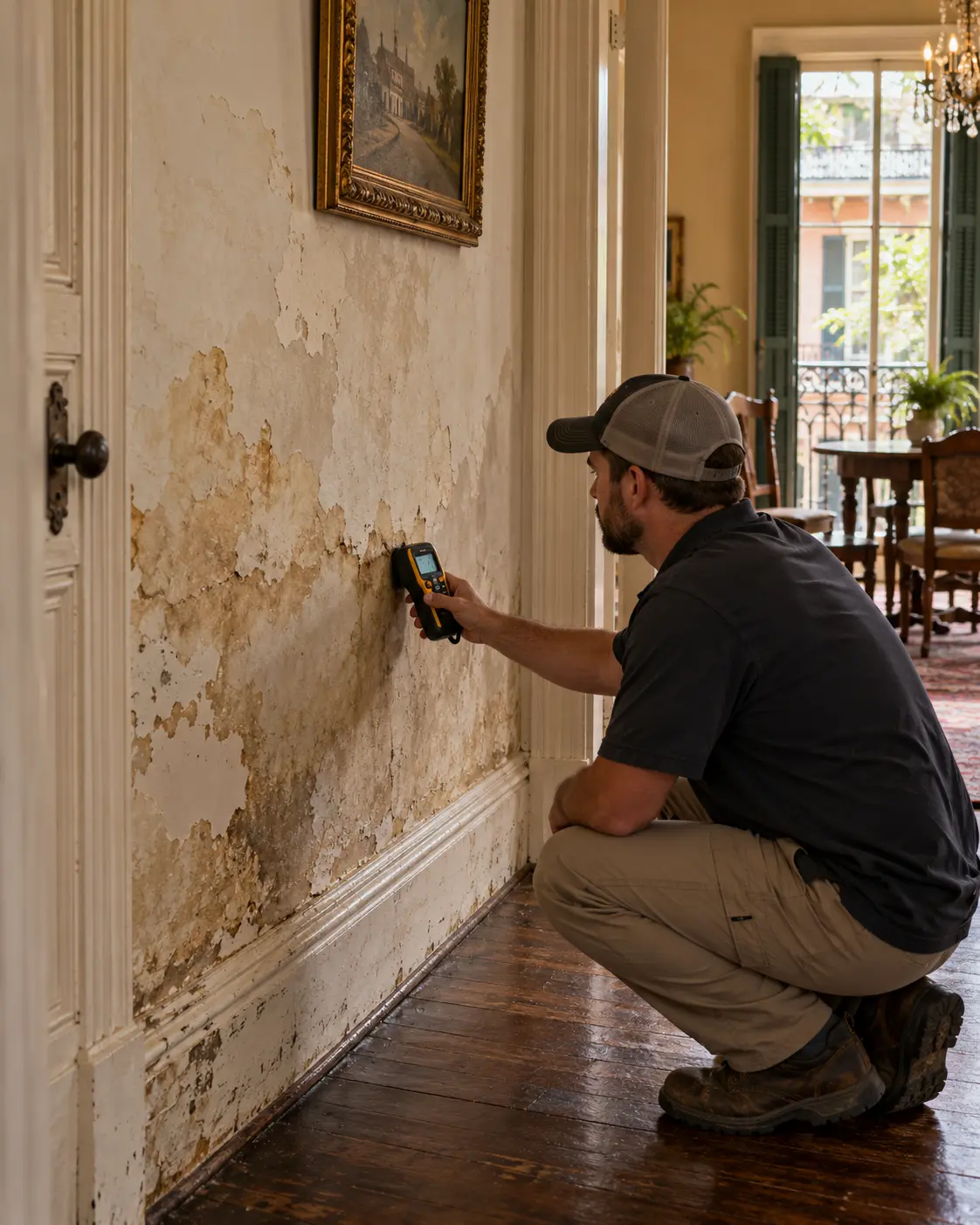
Removing a puddle or drying a visible stain does not necessarily remove water from layered materials. What should be checked depends on where the water originated and which materials were connected to the wet area.
Water from roofs, upper units or overhead plumbing can affect ceiling finishes, framing and materials above the visible surface.
Moisture can move behind plaster or drywall, around plumbing openings, through insulation or along framing.
Water can move under finished flooring into underlayment, subflooring or adjoining areas even after the surface begins to feel dry.
Kitchen or appliance leaks can reach cabinet bases, toe kicks and flooring behind or beneath fixed components.
In attached or multi-level residential buildings, water can move between spaces through ceilings, walls, floors or shared pathways.
Properties with multiple generations of wall, ceiling or flooring materials may require investigation before assuming only the visible finish became wet.
In a condominium or other multi-unit residential property, identifying the wet area is only part of the problem. The source may be inside the homeowner's unit, in another unit or connected to a shared building component.
A bathroom, appliance, roof or plumbing issue above a residence can first appear as ceiling or upper-wall damage in the unit below.
Water originating within the homeowner's residence may spread beneath floors, behind cabinets or into another space before all affected areas are obvious.
Common plumbing, roof assemblies or other building systems may require coordination beyond the interior restoration scope.
Drying or opening an affected assembly may require communication with an association, building representative or neighboring owner, depending on the property.
Ownership, maintenance responsibility and insurance questions depend on the property's documents, policies and individual facts. An independent restoration provider should not be expected to make legal determinations about financial responsibility.
Some French Quarter residences contain older or specialized materials, but no restoration plan should assume a material simply because of the address. The actual wall, ceiling, floor and structural assemblies should be identified before deciding what can remain, what can be dried and what may require access or replacement.
| Material / Assembly | Useful Questions After Water Damage |
|---|---|
| Plaster or layered wall finishes | Is the finish still bonded and structurally sound? What is behind it? Can the assembly be evaluated and appropriately dried without unnecessary removal? |
| Drywall | How wet is it? What type of water contacted it? Is insulation or another wet material behind it? |
| Wood flooring | Did water move beneath the surface? Is the flooring moving, swelling or cupping? What is happening in the layers below? |
| Structural wood | What is the moisture condition, physical condition and drying access before the assembly is closed? |
| Masonry | Is moisture limited to the surface, moving through adjoining materials or associated with another source that first needs correction? |
| Decorative trim / millwork | Can the component remain? Has swelling, separation, finish damage or moisture behind the material occurred? |
Interior water mitigation and exterior building repair are not always the same scope.
The City of New Orleans states that work proposed for the exterior of properties in the Vieux Carré requires Commission review. Its application guidance specifically includes roofing among exterior work subject to the process.
Certain interior projects that affect structural design or building integrity can also fall within the Commission's review process.
Review the current Vieux Carré Commission application process .

Drying a wet wall and rebuilding it are different stages. When later repair involves disturbing painted ceilings, walls, windows or other components in older housing, lead-safe renovation requirements may become relevant.
EPA's Renovation, Repair and Painting requirements generally apply to covered renovation work performed for compensation in pre-1978 housing when painted surfaces are disturbed, subject to the rule's requirements and exceptions.
Control the source, address immediate safety, remove appropriate standing water and evaluate affected building materials.
If painted surfaces in older housing need to be cut, sanded, removed or replaced, ask the contractor whether applicable EPA lead-safe requirements apply.
Review EPA lead-safe renovation guidance .
The Sewerage & Water Board of New Orleans documents a French Quarter Transmission Main project replacing approximately 115-year-old drinking-water transmission mains in specific project blocks, together with related water, sewer and drainage work.
That can be useful neighborhood information when residents encounter project-related street work or planned water disruptions. It does not establish the cause of water damage inside an individual residence.
See the SWBNO French Quarter Transmission Main project for current project information.
Different sources of water damage call for different services. Use the situations below to find more detailed information about the problem affecting your home.
| What You Are Seeing | Service Path | Main Question |
|---|---|---|
| Standing water inside the residence | Water Extraction | What removable water should be addressed before material drying? |
| Surface water is gone but walls, flooring or ceilings remain wet | Structural Drying | Which building materials are still retaining moisture? |
| Pipe or plumbing failure | Burst Pipe Water Damage | Has the plumbing source been stopped and where did the water travel? |
| Dishwasher, washer, refrigerator or similar appliance source | Appliance Leak Water Damage | Did moisture move beneath flooring, cabinets or adjoining areas? |
| Ceiling stain or water entering through the roof | Roof Leak Water Damage | Has the exterior source been controlled and what interior materials became wet? |
| Severe weather created one or more building-entry points | Storm Water Damage | Where did weather enter and is additional intrusion controlled? |
| Exterior floodwater entered the residence | Flood Cleanup | What contamination and material conditions resulted from outdoor water? |
| Sewage or wastewater entered | Sewage Backup Cleanup | Which materials were contaminated and what can appropriately remain? |
| Visible or suspected mold after unresolved moisture | Mold Remediation | Has the underlying moisture source also been corrected? |
The exact steps vary by water source, contamination, materials and access. However, a useful restoration plan should answer several questions in a logical order rather than starting with cosmetic repair.
Electrical conditions, unstable ceilings, contaminated water and other immediate hazards should be considered before cleanup begins.
Plumbing, appliances, roofing, exterior openings or another source should be controlled so additional water does not continue entering.
Indoor supply water, appliance discharge, outdoor floodwater and sewage should not automatically receive the same cleanup approach.
Evaluate visible damage and possible hidden moisture above, below, behind or beside the first wet surface.
Remove appropriate standing water and address moisture retained in building materials that can remain.
Permanent finish repairs should not simply conceal an unresolved water source, contamination problem or retained moisture.
Describe what happened, where the water is visible, whether standing water remains and whether the source has been stopped. Provider availability can then be checked for the residential request.
Residential homeowners • New Orleans service area • Provider availability varies
Removing visible water is only part of the recovery process. Moisture inside walls, ceilings, flooring, cabinets or other materials should be addressed before damaged areas are closed or refinished.
When the primary issue is retained moisture and no separate mold condition has been established, structural drying may be the more relevant service path.
Learn about structural drying →Visible growth, persistent musty odors or concealed areas that remained wet can turn the problem into a separate mold-remediation question.
Learn about mold remediation →EPA provides additional homeowner guidance in its guide to mold, moisture and the home .
Water damage can look very different after extraction, material access or drying begins. Basic documentation helps preserve the initial condition and explains why the restoration scope changes if concealed damage is discovered later.
Photograph the visible plumbing, appliance, roof, ceiling or other suspected source when it can be done safely.
Record standing water, stains, swollen materials, flooring, cabinets, walls, ceilings and affected belongings.
Include nearby rooms, ceilings or adjoining spaces when water may have traveled beyond the first visible location.
Retain relevant plumbing, appliance, roofing or building repair information describing how additional water entry was controlled.
If hidden moisture or damaged materials are discovered after access, document the newly exposed condition.
Keep relevant final photographs, invoices and drying or moisture documentation when supplied.
Ask whether the source is plumbing, an appliance, roof intrusion, stormwater, exterior flooding, sewage or another cause.
Drying will not solve a condition that continues releasing water into the same building assembly.
Ask what was checked beyond the visible stain or puddle, including floors, walls, ceilings and adjoining spaces where relevant.
Ask why a material can be dried, cleaned, opened or removed instead of treating every wet surface the same way.
Verify the independent provider's qualifications, licensing, insurance and proposed scope as applicable before hiring.
For French Quarter exterior or structural work, confirm whether VCC, City or other approvals apply to the permanent repair scope.
This page focuses specifically on residential considerations in the French Quarter and nearby CBD. For the main citywide restoration overview, visit our New Orleans water-damage homepage.
First address immediate safety and stop additional water if it can be done safely. Then identify the likely source, whether standing water remains and which walls, ceilings, flooring or adjoining spaces may have become wet.
No. It is intended for qualifying residential homeowner requests in the French Quarter area. Building age, materials and historic status should be verified for the individual property rather than assumed from its neighborhood.
Sometimes. If the source or affected area involves common plumbing, a shared roof, another unit or another building component, coordination with an association or building representative may be necessary.
No. Extraction removes removable water. Flooring systems, ceilings, walls, cabinets, insulation and structural materials can retain moisture after visible water is gone.
Not automatically. Material type, water source, physical condition, saturation, contamination, access and drying potential should be evaluated before removal decisions are made.
The City states that exterior work in the Vieux Carré is subject to VCC review, and certain structural interior projects can also fall within its process. Requirements depend on the proposed scope.
Wet materials can create conditions that support mold growth when moisture remains. Correcting the source and addressing retained moisture are important before affected areas are closed or refinished.
Yes. The French Quarter is the primary focus, while nearby CBD residential homeowner requests are also addressed when the property falls within the New Orleans city service area.
No. This service is intended for qualifying residential homeowner requests. Commercial restoration requests are outside its scope.
Homeowners can call (866) 203-7057 and describe the location, water source, affected areas and current conditions to check provider availability.
If you own a residential property in the French Quarter or nearby CBD and are dealing with a leak, flooding, standing water, wet ceilings, damaged flooring or hidden moisture, call to describe the situation and check whether an independent local provider connection is available.
This website helps homeowners connect with independent local providers. It does not perform restoration work directly. Availability depends on the location, request type and provider capacity. Homeowners should verify applicable licensing, insurance and qualifications before hiring.