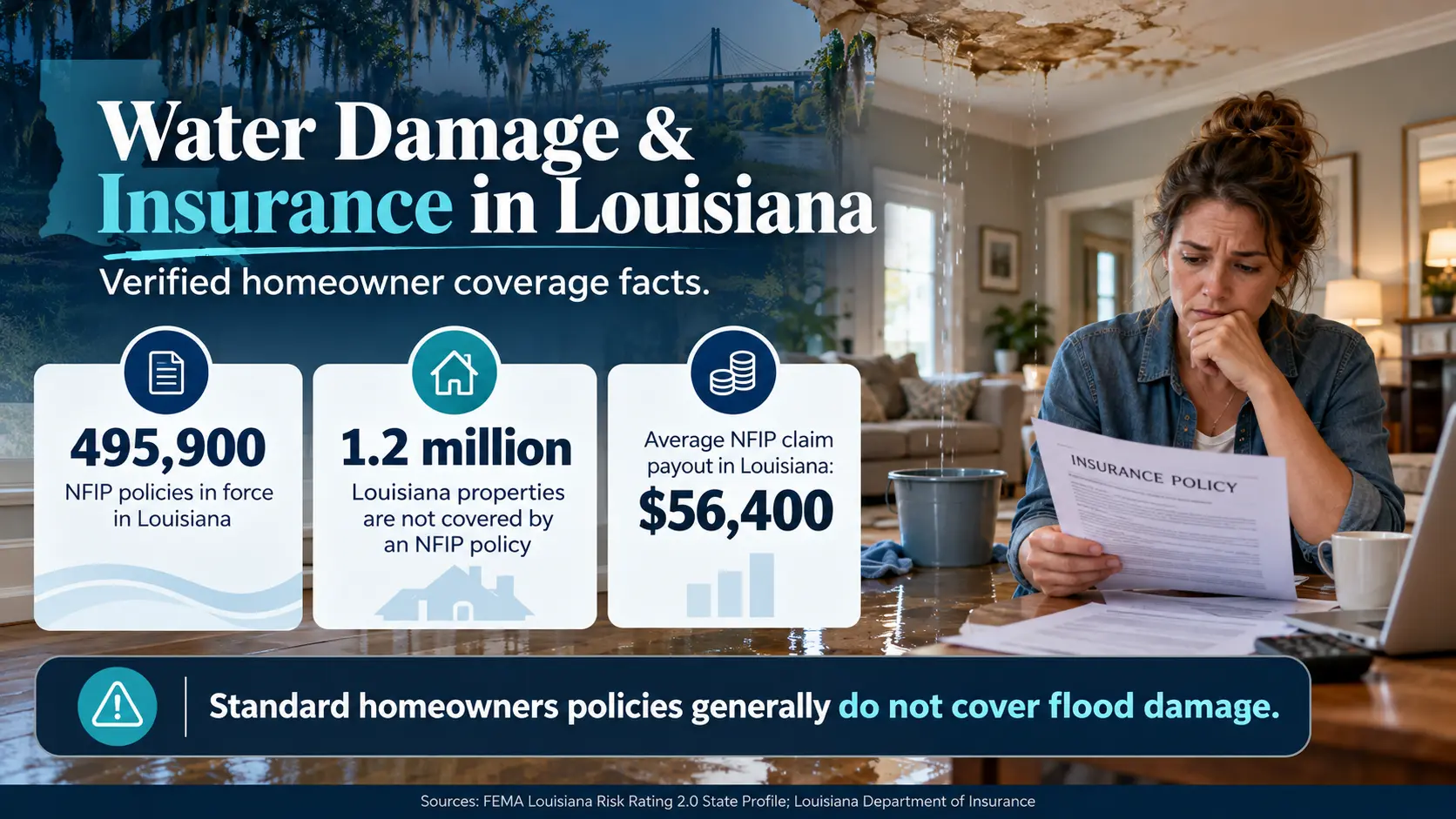
Water damage in Louisiana may be covered by homeowners insurance when it results from a sudden, accidental event, such as a burst pipe. Flooding generally requires separate flood insurance, while sewer backups often require additional coverage. The cause of the damage, exclusions, and deductible determine whether an insurer will pay.
A plumbing failure, a storm-damaged roof, and rising street water can all leave a New Orleans home soaked. Yet those situations may involve different insurance policies. This guide explains what to check, how to document damage, and why cleanup sometimes needs to begin before the insurance decision is complete.
Water Damage Happening Right Now?
Call to check whether an independent local service provider is available for your New Orleans home. Insurance questions can be addressed while reasonable steps are taken to prevent further damage.
Call (866) 203-7057Residential homeowner requests only. Availability depends on request type and provider capacity.
Where Did the Water Come From?
The source of the water is often the first question an insurance adjuster needs to investigate. A wet floor does not establish whether the loss started with plumbing, storm damage, flooding, or a sewer backup.
Original educational illustration showing common sources of water damage, not a specific New Orleans property.
This illustration is educational. The water source alone does not guarantee coverage. Multiple causes can affect one loss, and the policy terms determine the applicable coverage.
What Types of Water Damage Does Homeowners Insurance Cover?
Start by identifying the water source. Then check which policy or endorsement may respond. The table below provides general guidance, not a decision about an individual claim.
| Water Damage | Possible Coverage | Important Limitation |
|---|---|---|
| Sudden burst pipe | Homeowners policy | Resulting damage may be covered. The failed pipe itself may be treated separately. |
| Unexpected appliance leak | Homeowners policy | Gradual leaks and deterioration may be excluded. |
| Rain through storm-damaged roofing | Homeowners or windstorm coverage | Cause of damage and storm deductibles matter. |
| Rising street floodwater | Separate flood policy | Standard homeowners policies generally exclude flooding. |
| Sewage backup | Water-backup endorsement or another applicable provision | Standard policies usually exclude sewer and drain backups. |
| Gradual foundation seepage | Often excluded | Flood coverage requires a qualifying insured event. |
| Mold after water damage | Depends on cause and policy | Mold exclusions, limitations, and endorsements may apply. |
General coverage guidance: Louisiana Department of Insurance — Homeowners Insurance .
Does Insurance Cover a Burst Pipe in Louisiana?
Homeowners insurance may cover damage from a sudden, accidental pipe failure. Resulting damage to walls, flooring, cabinets, and other covered property may qualify even when replacing the failed pipe itself does not.
Sudden Pipe Failure Versus a Gradual Leak
For example, a supply line may rupture overnight and soak a kitchen floor before anyone discovers it. That can differ from a small leak that has damaged a subfloor over several months.
As a result, the insurer may investigate when the water escaped, why the pipe failed, and whether the policy excludes the cause.
If a plumbing failure has affected your home, see our guide to burst pipe water damage in New Orleans .
Does Insurance Cover Water Damage From Appliances?
Sudden discharge from a dishwasher, washing machine, or water heater may fall under homeowners coverage. By contrast, a long-standing leak beneath the same appliance may not.
Appliance Repairs and Building Damage Are Different
An insurer can treat damage to the building differently from the cost of repairing the failed appliance.
Additionally, the extent of water damage should be established rather than assumed from a visible floor stain. Water may have reached cabinets, adjoining rooms, or concealed materials.
Our appliance leak water damage guide explains common hidden-moisture concerns.
Does Homeowners Insurance Cover Rain and Storm Damage?
Coverage depends on how water entered the building. A storm-damaged roof and water rising from a flooded street can produce similar interior damage but may involve different policies.
Wind Damages the Roof
Rain enters through an opening caused by covered wind damage. Applicable homeowners or windstorm coverage may respond, subject to the policy.
Street Water Enters the Home
Rising outdoor water flows through a doorway. This generally raises a separate flood-insurance question rather than ordinary homeowners coverage.
Check Hurricane and Named-Storm Deductibles
Louisiana homeowners may have hurricane or named-storm deductibles that differ from ordinary deductibles.
Therefore, checking the declarations page can help homeowners understand their potential out-of-pocket responsibility.
The Louisiana Department of Insurance recovery resources provide documentation and claim guidance.
For interior property damage, see our storm water damage page .
Does Homeowners Insurance Cover Flood Damage in New Orleans?
Standard homeowners insurance generally does not cover flooding. Separate flood insurance is available through the National Flood Insurance Program (NFIP) and private insurers.
This distinction matters in New Orleans, where different rainfall and storm-related events can create different forms of water intrusion.
NFIP Waiting Periods and Claim Deadlines
Flood insurance waiting periods and claim requirements can affect homeowners after a loss. Therefore, review the relevant documents before an emergency occurs.
Published program rules, not estimates of claim approval rates or insurance payouts.
New NFIP policies generally have a 30-day waiting period before coverage becomes effective. Specific exceptions apply.
NFIP proof-of-loss documentation is generally due within 60 days of the flood, unless an applicable extension or different instruction applies.
Sources: NFIP Policy Information and NFIP Claims Checklist . Always confirm applicable deadlines directly with your insurer.
What About Raised New Orleans Houses?
Some NFIP policies restrict coverage for certain basements and enclosures beneath elevated buildings.
For that reason, homeowners should check how their policies treat stored belongings, utilities, and enclosed spaces below the elevated floor.
This does not mean every raised home has the same coverage. Building configuration and policy wording matter.
See Louisiana flood insurance guidance for official information.
If floodwater has entered your home, our New Orleans flood cleanup guide explains restoration-related concerns.
Consequently, damage may involve separate policies. A visible waterline alone does not determine the cause of every damaged item or which policy applies.
Is Sewage Backup Covered by Homeowners Insurance in Louisiana?
Standard homeowners policies generally exclude sewer and drain backups.
Therefore, homeowners commonly need an optional water-backup endorsement or another applicable policy provision for this type of loss.
When Wastewater Enters the Living Space
For example, wastewater may rise through a shower drain and spread across a bathroom floor.
Whether cleanup and resulting building damage are covered depends on the water source, endorsement wording, applicable limits, deductibles, and exclusions.
- Do I have water or sewer backup coverage?
- What is the maximum available coverage?
- Which deductible applies?
- Does the applicable coverage include contaminated cleanup and damaged building materials?
The Insurance Information Institute explains common homeowners insurance exclusions.
If sewage has entered your home, avoid contact with contaminated water. See our sewage backup cleanup information .
Does Homeowners Insurance Cover Mold After Water Damage?
Mold coverage varies. Mold associated with a sudden, covered plumbing failure may be treated differently from mold caused by years of moisture intrusion or unresolved humidity.
Why the Original Water Source Matters
Insurance policies can contain mold exclusions, coverage limits, endorsements, or specific conditions.
As a result, coverage for the original water damage does not automatically establish unlimited coverage for mold remediation.
Drying Still Matters Even When Coverage Is Uncertain
Insurance and moisture control are separate concerns. The EPA’s mold guidance emphasizes fixing moisture sources and drying affected materials promptly, ideally within 24–48 hours when possible.
For existing mold problems, visit our New Orleans mold remediation guide .
Should You File an Insurance Claim for Water Damage?
A claim may make sense when the apparent covered loss is significant compared with your deductible. However, filing a claim is not automatically the best financial choice for every small incident.
What to Review Before Filing
- Deductible: Which deductible applies to this event?
- Damage scope: Does the estimate include necessary cleanup, drying, and rebuilding?
- Coverage limits: Are there special limits for sewage or mold?
- Cause of water: Is the event covered or excluded?
- Claim history: Ask your agent about potential underwriting or premium implications.
Why Hurricane Deductibles Matter
A percentage-based deductible can be substantially higher than an ordinary fixed-dollar deductible.
Therefore, check the declarations page and confirm whether your loss triggers a hurricane, named-storm, or another deductible.
New Orleans homeowners have also described concerns about hurricane deductibles and separate flood coverage in a local Reddit discussion . These are self-reported experiences, not representative insurance costs or official coverage determinations.
Even when you are deciding whether to file a claim, document damage when safe and take reasonable steps to prevent additional loss.
What if the Insurance Adjuster Missed Hidden Water Damage?
An initial inspection may not reveal moisture behind walls, inside cabinets, or beneath flooring. The extent of affected materials can become clearer as the damage is investigated.
Document Damage Discovered Later
If additional damage is discovered, document it with photographs, moisture measurements where available, inspection notes, and an updated work scope.
Next, ask your insurer how to submit supplemental information for review.
An updated estimate does not automatically mean every additional repair is covered.
A homeowner discussion about concealed damage and insurance estimates illustrates why documenting later discoveries can matter.
This is a self-reported homeowner experience, not a rule that applies to every insurance claim.
Will Insurance Pay the Entire Water Mitigation Bill?
Not necessarily. Even when the underlying loss is covered, deductibles, exclusions, coverage limits, and disagreements about required work can affect reimbursement.
Hiring a water damage provider and receiving insurance reimbursement are separate matters. Therefore, a contractor’s invoice does not automatically guarantee insurer payment.
Before Signing a Work Authorization
Know What Is Included
Ask which areas and services the proposed work covers. Also request an explanation of the charges.
Know Who Pays
Review payment terms and understand your responsibility if insurance reimburses less than expected.
Keep Documentation
Retain authorizations, invoices, photographs, and available moisture records.
Review Before Authorizing
Ask questions about exclusions, cancellation terms, and additional charges when circumstances safely permit.
Need Residential Water Damage Assistance?
Call to check whether an independent local provider is available for your New Orleans home. Describe the water source and affected rooms.
Call (866) 203-7057We do not determine insurance coverage, adjust claims, or guarantee reimbursement.
Why Might a Water Damage Insurance Claim Be Denied?
Common reasons include an excluded cause of damage, gradual deterioration, insufficient documentation, policy conditions that were not satisfied, or limits on a particular category of loss.
What to Do After Receiving a Denial
First, request a written explanation identifying the policy provisions supporting the decision.
Next, ask how to submit additional evidence if relevant circumstances were overlooked.
The Louisiana Department of Insurance provides consumer assistance and information about insurance complaints.
Water Damage Right Now: Call Insurance or Start Cleanup?
Contact your insurer promptly, but do not wait unnecessarily to take reasonable steps that prevent additional damage. Safety comes first.
Practical homeowner checklist. Skip any action that could put you at risk.
- Check for immediate danger. Avoid water near electrical equipment, sagging ceilings, and contaminated sewage. Contact emergency services if necessary.
- Stop the water if safe. An accessible plumbing shutoff may prevent additional discharge. However, do not attempt dangerous electrical or roof work.
- Photograph the loss. Document affected rooms, belongings, visible moisture, and the apparent water source.
- Notify your insurer. Explain what happened and ask about documentation requirements and deadlines.
- Arrange reasonable mitigation. Depending on conditions, appropriate work may involve preventing further intrusion, water removal, or drying.
- Save your records. Keep invoices, receipts, estimates, photographs, and communications.
Official guidance: Louisiana Department of Insurance — Recovery After a Storm .
What Should New Orleans Homeowners Check Before a Storm?
Homeowners insurance and flood insurance are not interchangeable. Therefore, review your protection before a loss rather than assuming every water source is included.
Documents Worth Keeping Accessible
- Homeowners insurance declarations page
- Separate flood insurance, if purchased
- Hurricane and named-storm deductibles
- Water-backup endorsements and limits
- Mold-related exclusions or limits
- Claims contact information
- Household photographs and inventory
Finally, ask your licensed insurance agent to explain anything that remains unclear, especially whether different policies or deductibles apply to specific water sources.
Frequently Asked Questions
These answers address common Louisiana homeowner questions. Your specific policy always controls.
Does homeowners insurance cover water damage in Louisiana?
It may cover resulting damage from sudden, accidental events such as certain burst pipes or appliance failures. Flooding and gradual seepage are generally excluded, while sewer backups often require additional coverage.
Does homeowners insurance cover water mitigation?
Reasonable water removal and drying services may be covered when they address an insured loss. However, coverage depends on the cause of damage, necessary work, policy limits, and exclusions.
Does insurance pay for structural drying after a leak?
Professional drying may be covered after a sudden covered water loss. Therefore, keep documentation of affected materials, moisture readings, drying services, and related charges.
Does insurance cover water damage under flooring?
Possibly. Coverage depends on the water source, cause of damage, and policy provisions. Additionally, water trapped beneath flooring may require further assessment even when the exposed surface appears dry.
Does homeowners insurance cover sewage cleanup in Louisiana?
Standard policies generally exclude sewer and drain backups. However, a water-backup endorsement or another applicable provision may provide coverage, subject to limits and exclusions.
Does insurance cover drywall replacement after a water leak?
It may cover necessary drywall replacement following a covered event. The cause, material condition, policy terms, and scope of damage determine the result.
How much does insurance usually pay for water damage?
There is no standard payout. Reimbursement depends on covered damage, deductibles, policy limits, exclusions, and the applicable valuation method.
Is flooding from heavy rain covered by homeowners insurance?
Standard homeowners policies generally exclude rising or accumulating surface-water flooding. Instead, a separate flood policy may apply if the incident meets its coverage conditions.
Can one storm result in both homeowners and flood claims?
Yes. Wind-related building damage and qualifying flood damage can involve separate policies. Therefore, each type of damage must be evaluated according to its cause and the applicable terms.
Should I wait for an insurance adjuster before cleanup?
Not necessarily. Document the damage when safe, notify your insurer, and take reasonable steps to prevent further loss. Also keep records and ask about the insurer’s documentation requirements.
Need Help With Water Damage in New Orleans?
Whether the damage involves a burst pipe, an appliance leak, stormwater intrusion, or a sewage backup, protecting your home and limiting further loss are immediate priorities.
Call to check whether an independent local service provider is available for your residential water-damage request.
Call (866) 203-7057New Orleans residential homeowner requests only. Provider availability varies.